How Tallow Helps Eczema Prone Skin
Your Laundry Detergent Is Fragrance-Free. Your Food Is Organic. So Why Is Your Moisturizer Full of Chemicals Your Skin Can't Recognize?
By Birch & Oak
You've done the work.
You switched to fragrance-free detergent when your skin started reacting. You went gluten-free when your gut — and your skin — told you something was off. You buy organic when you can. You read labels. You declined the fluoride at your last dental appointment. You've got a water filter on your tap.
You've been paying attention. And your skin is still flaring.
Here's what nobody in the conventional skincare world wants to say:
The problem might be your moisturizer.
I know. Stay with me.
Your Skin Has a Blueprint. Most Creams Ignore It.
Your skin isn't passive. It produces its own oil — called sebum — specifically designed to protect it. Researchers have mapped exactly what that oil is made of: palmitic acid, stearic acid, oleic acid, and a handful of other fatty acids built into a precise, ordered structure.
That structure is your skin barrier. And when it breaks down, things get in that shouldn't — allergens, irritants, bacteria. That's the inflammation driving your flares.
This isn't a theory. A peer-reviewed study published in Experimental Dermatology confirmed that the stratum corneum lipid matrix — dominated by fatty acids, ceramides, and cholesterol — is directly impaired in atopic dermatitis. When the lipid wall breaks, the immune system goes into overdrive. The itch, the redness, the flares: all downstream effects of a depleted barrier.
So the question is simple: what are you putting on your skin to rebuild it?
If your answer is a drugstore cream or even a fancy "clean beauty" product — flip it over. Count the ingredients. Now ask yourself how many of those match what your skin actually produces.
I'll wait.
The Ingredient Your Skin Already Speaks
Beef tallow — rendered fat from grass-fed cattle — has a fatty acid profile that is remarkably close to human sebum. We're not talking about a loose resemblance. The same fatty acids your skin barrier is built from — oleic acid, palmitic acid, stearic acid — are the primary components of tallow.
A 2024 scoping review published in Cureus analyzed the existing research and concluded that tallow is biocompatible with human skin, with its lipid composition providing strong evidence that it can integrate with — rather than just sit on top of — the skin barrier.
Biocompatible. Your skin doesn't have to fight it. It doesn't have to trigger a low-grade immune response to something it's never encountered in nature. It just... uses it.
God literally put the blueprint in your own biology. The answer to what your skin needs has been there the whole time. We just got talked out of it.
What Eczema Skin Is Actually Missing
Here's the research that reframes everything.
A clinical study in Experimental Dermatology examined the fatty acid composition of the stratum corneum in eczema patients versus healthy skin. What they found was specific: eczema skin shows a measurable reduction in free fatty acid chain length, a less dense lipid organization, and a significantly impaired skin barrier function — all more pronounced in active lesions.
This isn't just dry skin. It's structurally deficient skin. The mortar between the bricks is depleted — and it's depleted of specific fats.
A 2025 PubMed study on emollient therapy for atopic dermatitis found that emollients containing physiological lipids — fats that mirror what the skin actually produces — showed measurable improvement in barrier repair compared to conventional formulations.
The research doesn't say "use tallow." But it absolutely says that the closer an ingredient is to what your skin naturally produces, the better it performs for barrier repair. And tallow is about as close as it gets.
So why isn't your dermatologist telling you this? That's a question worth sitting with.
The Grass-Fed Difference: CLA
This is where sourcing matters, and why grass-fed isn't just a marketing word.
Grass-fed beef fat contains conjugated linoleic acid — CLA. And CLA has a research trail that's genuinely impressive.
A study published in Experimental Dermatology tested topical CLA on atopic dermatitis-like skin in a controlled model. The results: CLA reduced inflammatory markers including IL-6, IL-1β, and TNF-α — the same cytokines that drive eczema flares. It also upregulated filaggrin, the skin barrier protein consistently deficient in eczema-prone skin. Scratching decreased. Inflammation cooled.
A separate study found that topical CLA inhibited allergic pruritus — the itch — when applied directly to skin.
Your conventional moisturizer doesn't contain CLA. It contains emulsifiers to blend oil and water, preservatives to extend shelf life, and penetration enhancers to drive those ingredients deeper into your skin. Each one is a potential irritant. Each one is something your skin has to process, respond to, or reject.
Tallow has none of that. Tallow is the active ingredient.
The Vitamins That Come With It
When you eat grass-fed beef, you get fat-soluble vitamins A, D, E, and K. Those same vitamins are present in the fat itself — which means they're in tallow. Not added in a lab. Not synthetic. Just there, the way they've always been.
-
Vitamin A: A peer-reviewed study confirmed that retinoids promote keratinocyte proliferation, strengthen the epidermis, and restrain transepidermal water loss. This is the same family of compounds that expensive prescription retinoids are based on. In tallow, it shows up in its natural form, in a fat your skin already knows how to absorb.
-
Vitamin E: A well-studied antioxidant that protects skin cell membranes from oxidative damage — relevant for anyone stuck in a chronic inflammation cycle.
-
Vitamin D: Topical vitamin D analogs are used clinically to treat psoriasis. Your skin can both absorb and use it.
These aren't marketing claims. They're just what's in the fat when you start with quality animals and don't strip it down to nothing.
"But Isn't That... Animal Fat on My Face?"
Yes. And here's my completely unsentimental answer to that:
You already eat it. You already cook with it if you have any sense. Your body produces a version of it every single day through your sebaceous glands. In fact, the Latin word sebum — the oil your skin makes — is essentially the same word as tallow.
The resistance to putting animal fat on your face is cultural, not biological. Your skin has zero resistance. It recognizes the fats in tallow the same way it recognizes the fats it makes itself.
The clean beauty industry spent a decade training us to feel that animal-derived ingredients are somehow less pure than a 40-ingredient synthetic cream made in a lab. And a lot of us bought it — literally. Meanwhile our skin kept flaring, and we kept buying the next thing they told us to try.
I say this with love: we've been played.
The Honest Caveat — Because You Deserve One
I'm not going to tell you tallow cures eczema. Large-scale clinical trials specifically on tallow haven't been done — the 2024 Cureus scoping review is upfront about that gap, and so am I.
What I can tell you is this: the individual components of tallow — its specific fatty acids, its CLA content, its fat-soluble vitamins — each have their own research trail. And the dermatological principle that skin-compatible lipids outperform foreign ones for barrier repair is well-established.
You've already made a dozen decisions based on that same kind of reasoning. You didn't wait for a 10,000-person clinical trial before switching to fragrance-free detergent. Your skin told you enough.
Simple Ingredients. Your Skin Already Knows All of Them.
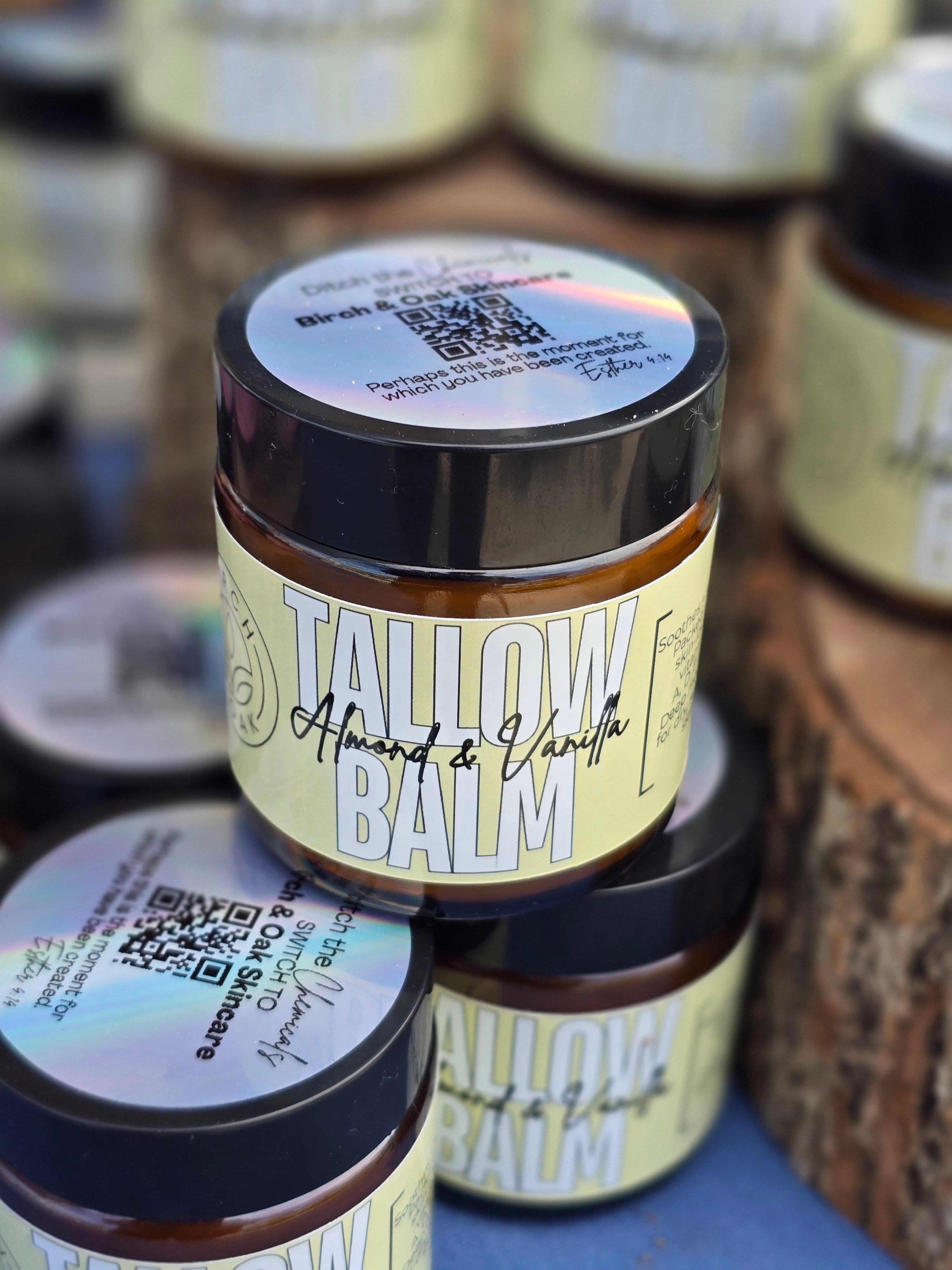
Birch & Oak tallow balm is made with a short, honest list — every ingredient chosen because your skin recognizes it, not because it extends shelf life or photographs well on a shelf.
The Original Tallow Balm contains grass-fed beef tallow and extra virgin olive oil. The olive oil serves one practical purpose: tallow rendered on its own is firm, and the olive oil softens it to make application easy. But it's not just a texture fix — olive oil is rich in oleic acid, the same dominant fatty acid in both tallow and human sebum. It's not diluting the formula. It's contributing to it.
The Almond & Vanilla Tallow Balm adds sweet almond oil and pure vanilla extract. Sweet almond oil is lightweight, easily absorbed, and rich in vitamin E and fatty acids that complement tallow's profile. Vanilla extract is just that — extract, not synthetic fragrance. No mystery compounds. No "parfum" hiding a cocktail of allergens.
That's the entire list.
No emulsifiers. No preservatives. No penetration enhancers. Nothing your skin has to fight, filter, or quietly react to at 2am when you can't figure out why you're itching again.
If you've done everything else right and your skin is still struggling — this is probably the step you haven't taken yet.
[Shop Birch & Oak Tallow Balm →]
Sources:
- van Smeden J, et al. The importance of free fatty acid chain length for the skin barrier function in atopic eczema patients. Exp Dermatol. 2014. PMID: 24299153
- Proksch E, et al. Stratum corneum lipids: their role for the skin barrier function. Exp Dermatol. 2016. PMID: 26844894
- Russell MF, et al. Tallow, rendered animal fat, and its biocompatibility with skin: a scoping review. Cureus. 2024. PMC11193910
- Tang Y, et al. Topical application with conjugated linoleic acid ameliorates atopic dermatitis-like lesions. Exp Dermatol. 2021. PMID: 33206422
- Jaudszus A, et al. Effects of CLA on allergic pruritus. PMID: 12499660
- Zasada M, Budzisz E. Retinoids: active molecules influencing skin structure formation. Adv Dermatol Allergol. 2019. PMC6791161
- Topical supplementation with physiological lipids rebalances stratum corneum ceramide profile. PubMed. 2025. PMID: 40408261


