The Ingredient Your Skin Recognizes as Its Own (And Why It Vanished for 100 Years)
There's a fat that matches your skin's own chemistry so closely that, on a molecular level, your cells can barely tell the difference between it and something they made themselves.
It's not a patented peptide. It's not in a $200 serum. It's not new.
It's tallow — rendered beef fat — and for most of human history, it was the default skincare ingredient. Then, in the span of a few decades in the early 1900s, it was quietly erased. Not because it stopped working. Because a soap company needed to sell a new product.
Here's the full, strange story — and the molecular science that explains why tallow is making such a dramatic comeback.
The Crisco Conspiracy: How One Company Rewrote What We Put on Our Skin
In 1911, Procter & Gamble had a problem. They'd just invented a new product — a hydrogenated cottonseed oil they called Crisco — and they needed Americans to adopt it fast. The obstacle standing in their way? Animal fats. Lard and tallow had been staples of American kitchens and medicine cabinets for generations, and nobody was in a rush to swap them out.
P&G's solution was one of the most effective marketing campaigns in food and personal care history. They hired home economists, published cookbooks that prominently featured Crisco, and ran relentless advertising portraying animal fats as dirty, old-fashioned, and unhealthy. They didn't just sell a product — they engineered a cultural shift around what "clean" meant.
It worked. By mid-century, lard and tallow had been largely displaced from American homes — not because science had condemned them, but because a corporation with a new product to sell had successfully made them seem backwards.
The irony? The trans fats created by hydrogenating those vegetable oils — the process that makes Crisco shelf-stable — turned out to be genuinely dangerous. The FDA banned partially hydrogenated oils in 2018. Meanwhile, tallow, the ingredient that was never actually proven problematic, had spent decades in exile.

Your grandmother's skincare routine wasn't primitive. It was just inconvenient for someone's quarterly earnings.
The Molecular Secret: Why Your Skin Thinks Tallow Is Family

Here's where things get genuinely fascinating, and where the science backs up what our ancestors figured out empirically.
Your skin produces its own fat — called sebum — to keep itself moisturized, supple, and protected. Sebum is a complex mix of fatty acids, and its profile looks roughly like this: about 57% oleic acid, 26% palmitic acid, and a meaningful proportion of stearic acid, plus smaller amounts of other lipids.
Now look at the fatty acid profile of grass-fed beef tallow: approximately 47% oleic acid, 26% palmitic acid, 14% stearic acid.
These numbers are not a coincidence. They're remarkably close — close enough that researchers studying skin barrier function have noted tallow's "skin-identical" lipid composition. What this means practically is that when you apply tallow to your skin, you're not laying a foreign film over it. You're feeding it molecules it already knows how to use.
Most mainstream moisturizers work differently. Silicones (dimethicone, cyclomethicone) create a smooth, waterproof film on the surface of your skin — they reduce water loss, but they don't actually integrate with your skin's biology. Mineral oil does something similar. They're essentially a plastic wrap strategy: seal moisture in from the outside. Your skin cells don't absorb or metabolize them. They just sit on top.
Tallow, by contrast, is bioavailable. The fatty acids are small enough and similar enough to your own sebum that they can penetrate the skin barrier and actually participate in its function. Dry, flaky skin isn't just missing a surface sealant — it's often deficient in the lipids that make up the skin barrier itself. Tallow can help replenish those.
This is also why tallow tends to absorb without leaving the thick, greasy residue you might expect. Once your skin recognizes those fatty acids, it gets to work on them.
The Grass-Fed Difference (This Part Actually Matters)
Not all tallow is equal, and this is the part that separates a well-made grass-fed tallow balm from whatever's in a generic tin at a bulk supplier.
Grass-fed beef tallow contains significantly higher levels of fat-soluble vitamins — specifically vitamins A, D, E, and K — compared to tallow from grain-fed animals. These aren't incidental extras. Vitamin A (retinol) is the compound that modern dermatology has spent decades synthesizing into prescription creams. Vitamin D plays a role in skin cell regulation and immunity. Vitamin E is a well-established antioxidant that supports wound healing and reduces oxidative stress in the skin.
When you use a grass-fed tallow balm, you're getting those nutrients in their whole, unprocessed form — the way they were before the supplement aisle existed.
There's also the matter of conjugated linoleic acid (CLA), a fatty acid found in notably higher concentrations in grass-fed animals. CLA has been studied for its anti-inflammatory properties, which matters for anyone dealing with reactive or sensitive skin.
The standard for quality tallow starts at the pasture. It's worth knowing where yours comes from.
Who's Quietly Returning to Tallow (And Why They're Not Shouting About It)
The tallow comeback has been happening for years in certain circles — ancestral health communities, traditional herbalists, clean beauty advocates who read ingredient labels like legal documents. It's not a fringe movement anymore. Dermatologists who specialize in the skin microbiome have begun discussing the skin-identical lipid argument publicly. Estheticians who work with extremely sensitive or compromised skin barriers have been recommending it quietly to clients for whom conventional moisturizers cause more problems than they solve.
The people who find their way to tallow tend to share a common thread: they've tried everything on the shelf and found it lacking. Synthetic moisturizers that work until they don't. "Natural" products that are mostly water with a preservative system keeping them shelf-stable. Expensive serums with one hero ingredient buried in a base of dimethicone.
Tallow is what happens when you stop asking the cosmetic industry what to put on your skin and start asking biology instead.
The Simple Version
You don't need to be a lipid biochemist to use tallow. The practical summary is this: it's a deeply nourishing fat with a molecular profile close enough to your skin's own sebum that your skin cells recognize and absorb it, it contains fat-soluble vitamins that most modern skincare strips out or synthesizes poorly, and it has been used by humans across cultures for thousands of years without a propaganda campaign needed to sell it.
The only reason it feels like a discovery is because we were convinced, about a hundred years ago, to throw it out.
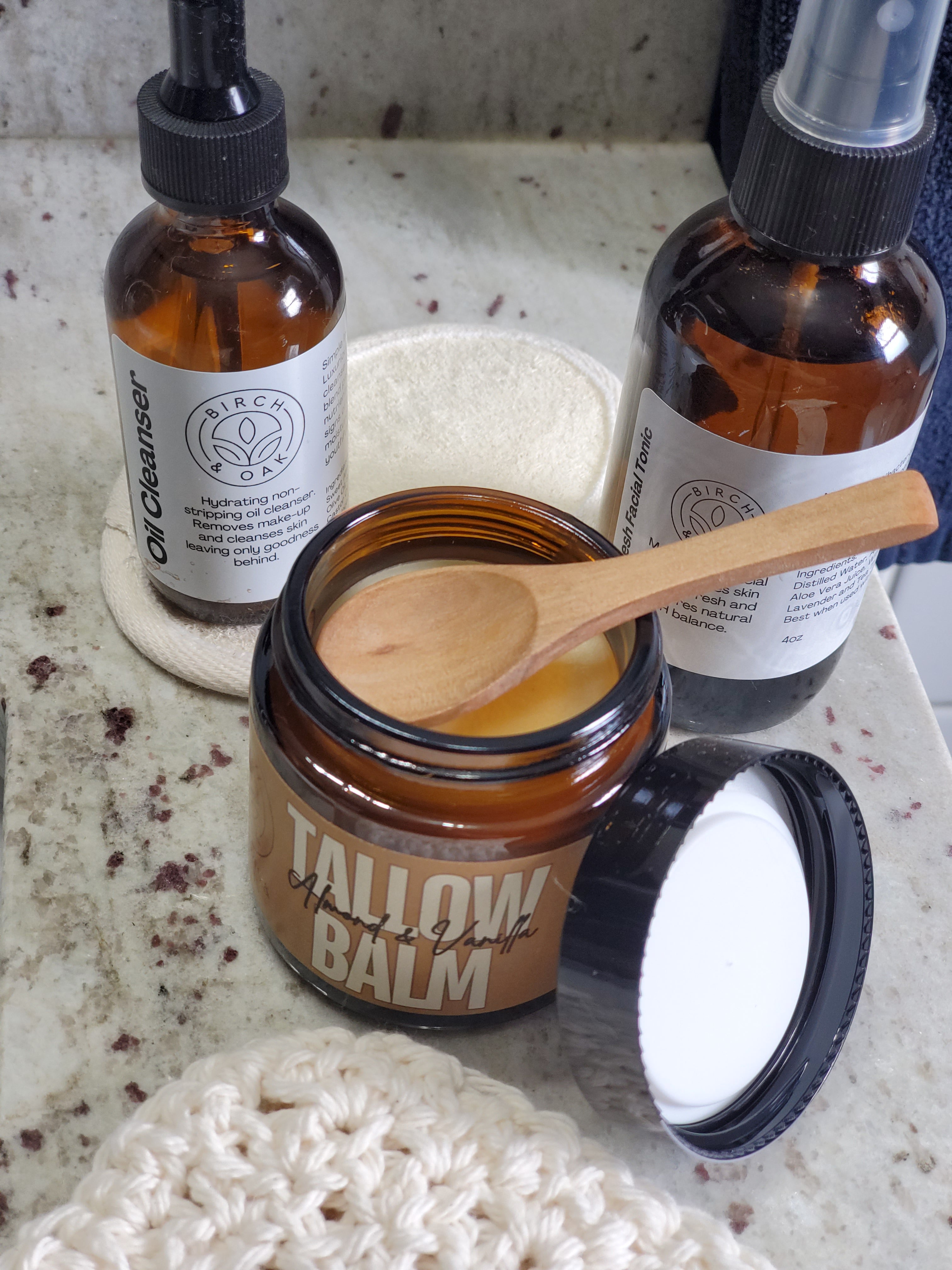
Our grass-fed tallow balm is made with one goal: get the good stuff back onto your skin with nothing between you and it. No silicones, no mineral oil, no synthetic preservatives. Just tallow, rendered slowly, sourced from grass-fed cattle, and finished with ingredients your skin already speaks.
If you've been searching for a moisturizer that actually works instead of just sitting on the surface — this is where that search ends.