The Preservative in Your Moisturizer That's Acting Like Estrogen in Your Body
There's a word that appears on nearly every moisturizer label in America. It shows up in face creams, body lotions, eye creams, and hand lotions — almost always buried near the end of the ingredient list, right where most people stop reading.
The word is paraben. And it's been quietly acting like estrogen inside your body every time you apply those products.

Here's what the label doesn't tell you.
What Parabens Actually Are — And Why They're Everywhere
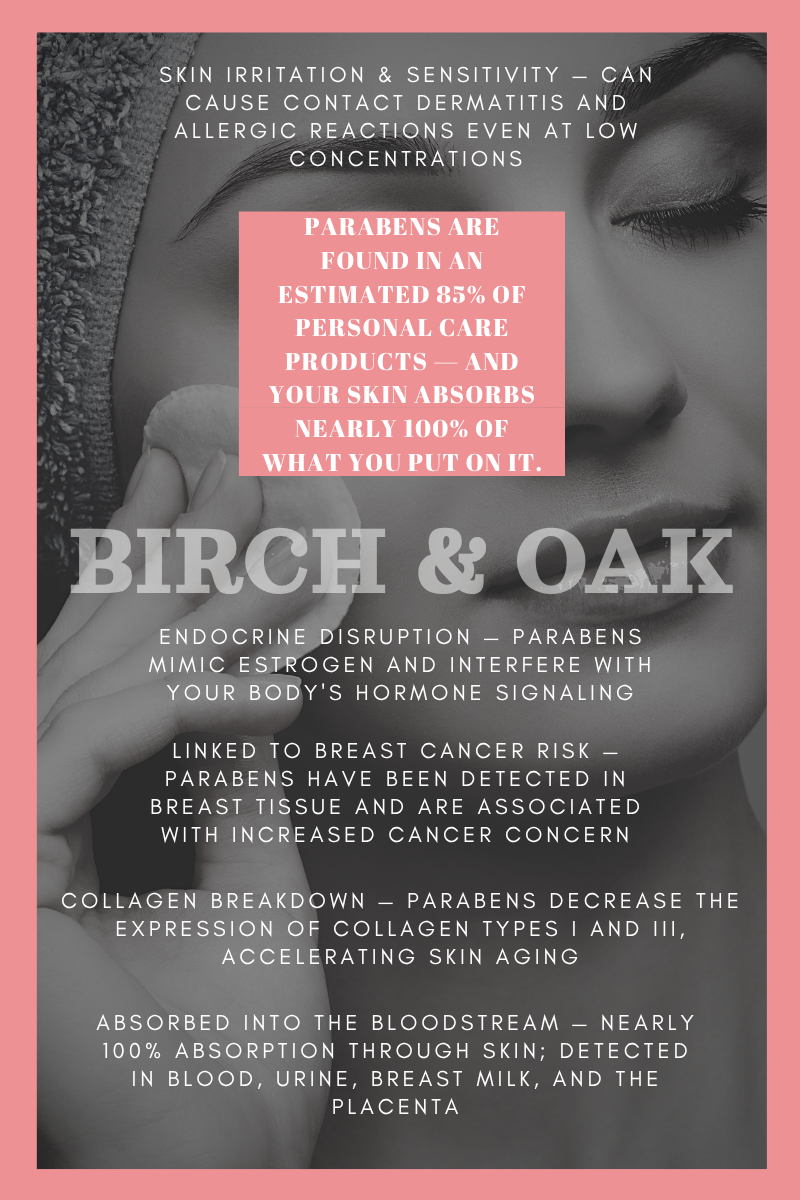
Parabens are synthetic preservatives. Their job is to prevent bacteria and mold from growing in your moisturizer — and they do that job extremely well, which is why the cosmetic industry has relied on them since the 1950s. Methylparaben, propylparaben, butylparaben, ethylparaben: you'll find one or more of these in an estimated 85% of leave-on personal care products.
The appeal, from a manufacturer's standpoint, is obvious. Parabens are cheap, stable, and effective against a broad spectrum of microbes. They're why a lotion you bought two years ago can still pass a contamination test today.
But there's a problem — one that's been documented in peer-reviewed research since the late 1990s. And it has to do with what parabens do once they get past your skin.
Your Skin Is Not a Barrier to Parabens. It's a Delivery System.
One of the most common assumptions people make about skincare is that what you put on your skin stays on your skin. It doesn't.
Your skin is a selectively permeable membrane, not a sealed wall. Lipid-soluble compounds — and parabens are lipid-soluble — can penetrate the skin barrier, enter the bloodstream, and circulate through your body.
A 2004 study published in the Journal of Applied Toxicology by Dr. Philippa Darbre detected intact parabens — methylparaben, propylparaben, and butylparaben — in human breast tumor tissue. All 20 samples tested positive. Not blood levels. Not urine excretion. Intact parabens, inside breast tissue, still recognizable as the compounds in your lotion.
Since then, parabens have been detected in urine, blood plasma, seminal fluid, and breast milk. A 2016 study found parabens in the cord blood of newborns — meaning maternal exposure crosses the placenta. You're not just absorbing what you apply. You're passing it on.
The Estrogen Problem — And What "Endocrine Disruptor" Actually Means
Parabens are classified as xenoestrogens — synthetic compounds that mimic estrogen in the body. They bind to estrogen receptors and activate them, triggering the same responses your body's own hormones would trigger.
For years, the cosmetic industry's defense was that parabens were too weak to matter — they activate estrogen receptors at a fraction of the strength of natural estrogen. That argument hasn't aged well.
Estrogen isn't just a reproductive hormone. Estrogen receptors are found in breast tissue, the uterus, the thyroid, bone, the brain, and cardiovascular tissue. The endocrine system operates on signals measured in parts per trillion. Chronic, repeated exposures — even at low individual doses — don't need to be large to be biologically meaningful.
A 2002 study in Archives of Toxicology demonstrated that butylparaben, the most potent of the common cosmetic parabens, disrupted reproductive development in male rats at doses relevant to human exposure. Sperm count decreased. Testosterone dropped. The effect was dose-dependent.
A 2014 study in Environmental Health Perspectives found that propylparaben altered the expression of genes involved in breast cancer cell proliferation — not just acting as a weak estrogen, but changing how cancer-relevant genes were being expressed.
In 2012, the European Union restricted butylparaben and propylparaben in leave-on products applied to the diaper area of children. Denmark banned five parabens from products intended for children under three. The EU's Scientific Committee on Consumer Safety concluded that combined exposure to multiple parabens — which is what happens when you use more than one personal care product daily — requires precautionary limits that most regulatory bodies still haven't adopted.
The United States has not restricted parabens at the federal level. The FDA acknowledges their estrogenic activity. Their safety evaluation, however, is based on individual products — not cumulative exposure across the multiple paraben-containing products a typical person uses in a day.
That gap is where the risk actually lives.
The "Cocktail Effect": What Happens When You Layer Products All Day
Here's the math nobody in the regulatory world is doing for you.
You wake up and wash your face with a cleanser that contains methylparaben. Apply toner with ethylparaben. A moisturizer with propylparaben and methylparaben. SPF with methylparaben. Hand lotion applied twice before noon, each application adding another dose of propylparaben.
Each of those products was evaluated individually. Each one, on its own, may fall within acceptable limits. But you're not using one product in isolation. You're stacking them, all day, every day, year after year.
A 2010 study in Reproductive Toxicology demonstrated that combinations of parabens show additive estrogenic effects. They don't cancel each other out. They add. Some researchers have found synergistic effects, where the combined impact exceeds the simple sum of individual exposures.
Your daily routine isn't being safety-tested. Individual ingredients are. That's a meaningful distinction — and one the industry doesn't have a financial incentive to close.
Why Tallow Doesn't Have This Problem
Here's the thing about traditional ingredients: they don't need preservatives.
Parabens exist because modern moisturizers are mostly water. Water-based formulas are a hospitable environment for bacterial growth — without preservatives, they'd spoil. Parabens are the solution to a problem that was created by the formula itself.
Tallow contains no water. It's pure rendered fat — specifically the fat from grass-fed cattle — with a fatty acid profile that closely mirrors your skin's own sebum. Oleic acid, palmitic acid, stearic acid: the same fats your skin barrier is built from. Pure fat doesn't harbor bacteria the way water-based formulas do. It doesn't need a chemical system to keep it shelf-stable for two years.
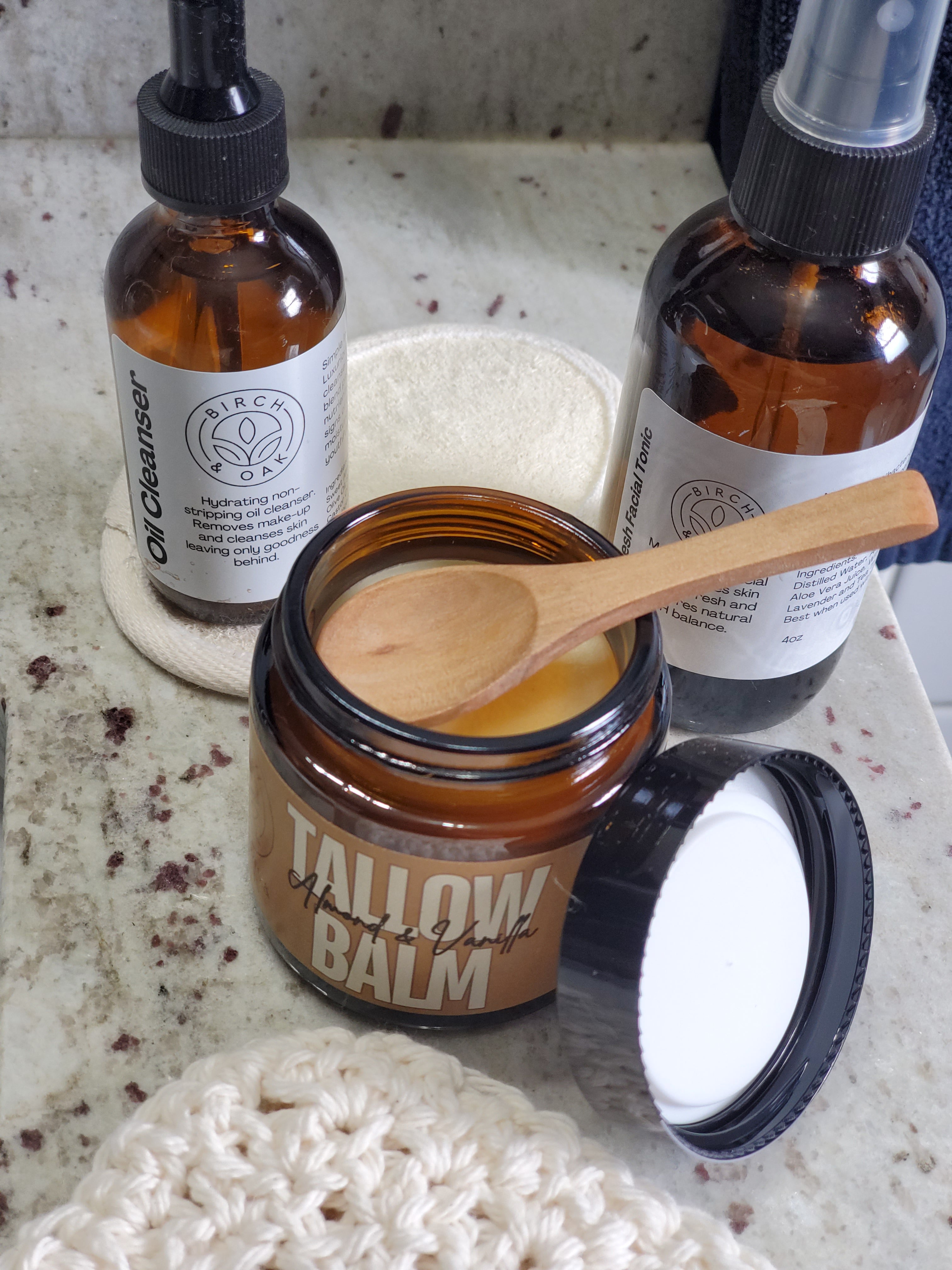
Birch & Oak tallow balm contains two ingredients: grass-fed beef tallow and extra virgin olive oil. Both are fats. Neither requires a synthetic preservative. There's no water to protect against — which means no paraben needed, which means no endocrine-disrupting compound cycling through your bloodstream every time you moisturize.
This isn't a feature we added. It's a feature that comes from starting with the right ingredients.
What to Do With This Information
Flip over your current moisturizer. Find the parabens — they'll be in the second half of the ingredient list, probably listed as methylparaben, propylparaben, or both. Then pull out your face wash, your SPF, your hand lotion. Count the products. Count the daily exposures.
You've already made choices to reduce your chemical load elsewhere — your detergent, your food, your water. This is the same calculation applied to something you're rubbing directly into your skin, every day, for decades.
Your skin deserves the same standard you've already set everywhere else.
Our tallow balm is a direct answer to that standard: one fat your skin recognizes, from grass-fed cattle, with nothing between you and it. No parabens. No water. No estrogenic preservatives. Just the ingredient your skin was designed to work with.
Shop Birch & Oak Tallow Balm →
Disclaimer: This post is for educational purposes and is not medical advice. Consult a healthcare provider with questions about hormone health or ingredient safety. Sources: Darbre PD, et al. J Appl Toxicol. 2004. PMID: 14745841; Moos RK, et al. Environ Int. 2016 (cord blood); Taxvig C, et al. Arch Toxicol. 2002; Wróbel AM, Gregoraszczuk EL. Environ Health Perspect. 2014; Calafat AM, et al. Int J Environ Res Public Health. 2010; EU SCCS Opinion on Parabens. 2013; Tavares RS, et al. Reprod Toxicol. 2010. PMID: 19925857.
Birch & Oak | thebirchandoak.com